
NATIONAL EXECUTIVE COUNCIL (NEC) The National Executive Council is the largest policy body of the...

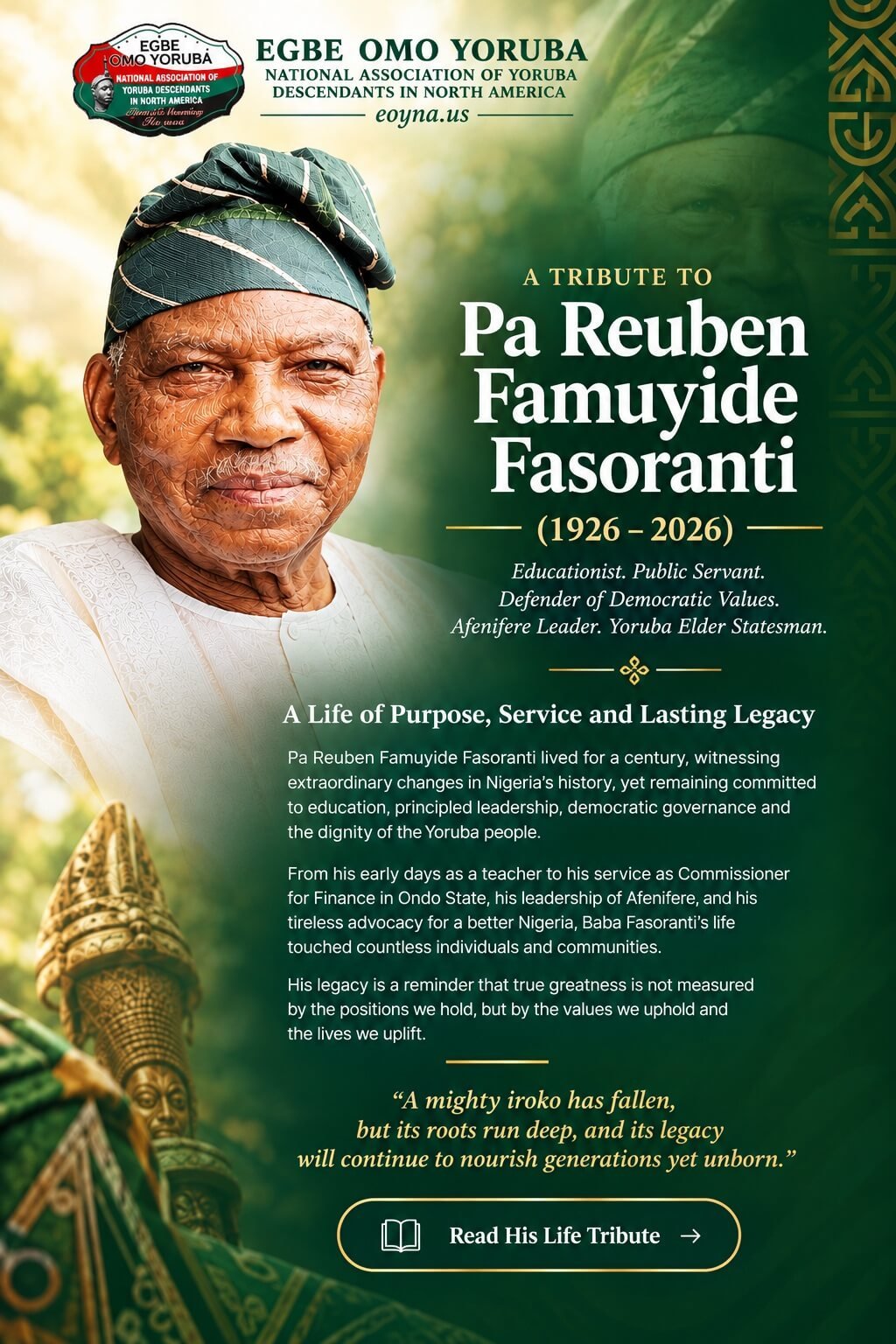
Some lives are measured in years, while others are measured by the values they uphold, the people they inspire, and the institutions they leave behind. The life of Pa Reuben Famuyide Fasoranti belongs to the latter. He lived for a century, witnessing extraordinary transformations in Nigeria’s history, yet remaining committed to education, principled leadership, democratic governance, and the dignity of the Yoruba people.
Pa Fasoranti passed away on October 20, 2026, at the age of 100. His departure marks the end of a remarkable personal journey, but not the end of the influence of his ideas, convictions, and service. He leaves behind a legacy that extends beyond his family and community to the Yoruba nation and Nigeria as a whole.
To many, Baba Fasoranti was a respected elder statesman. To others, he was a teacher, a political leader, a guardian of Yoruba identity, and a voice of conscience. To generations who may never have met him, his life offers an enduring lesson: that true greatness is found not merely in the positions one occupies, but in the principles one preserves and the good one does for others.
Born on May 11, 1926, in Uso, in present-day Ondo State, Pa Fasoranti grew up in an era when educational opportunities were limited and Nigeria was still under British colonial rule. His journey from those early beginnings to national prominence reflects the power of education, perseverance, discipline, and a clear sense of purpose.
His educational journey took him through St. Andrew’s Primary School in Owo and Ondo Boys’ High School, followed by further studies at Yaba Higher College in Lagos and the University College, Ibadan, now the University of Ibadan. He subsequently pursued advanced studies in education in the United Kingdom and Australia.
These experiences prepared him for a career that would shape not only his own life but also the lives of countless young Nigerians. His story reminds us that circumstances may influence our beginnings, but determination, learning, and service can expand the possibilities of our future.
Before he became widely known as a political leader and elder statesman, Pa Fasoranti was first and foremost an educationist. His career in education reflected a conviction that the progress of any community depends substantially on the quality of education available to its people.
He taught at Ondo Boys’ High School and served in school leadership positions at several institutions, including Anglican Grammar School, Iju-Itaogbolu, and Christ’s School, Ado-Ekiti. At Anglican Grammar School, he served as principal for many years, helping to establish a tradition of learning and discipline.
His commitment to education continued beyond his formal teaching career. He established educational institutions, including Omolere Nursery and Primary School, Akure High School, and St. Frances’ Academy in Igoba, Akure.
These contributions reflected a vision that extended beyond personal achievement. He understood that educating a child was an investment in a family, a community, and the future of society.
A teacher’s influence does not end when a student leaves the classroom. It continues in the decisions that student makes, the people that student serves, and the values passed on to the next generation. In this sense, Pa Fasoranti’s educational legacy reaches far beyond school walls.
His life challenges parents, teachers, community leaders, and institutions to continue investing in young people. Buildings may age, and generations may change, but the gift of knowledge remains one of the most enduring contributions anyone can make to humanity.
Pa Fasoranti’s commitment to service extended from the classroom into public life. Influenced by the progressive political philosophy of Chief Obafemi Awolowo, he became associated with the Action Group and later the Unity Party of Nigeria.
His political journey was grounded in ideals associated with education, social welfare, accountability, responsible government, and the advancement of ordinary citizens.
During the Second Republic, he served as Commissioner for Finance in the old Ondo State under the administration of Governor Michael Adekunle Ajasin from 1979 to 1983. His public service placed him among those entrusted with the responsibility of translating political convictions into practical governance.
For Pa Fasoranti, public life was not simply about holding office or gaining recognition. It was an opportunity to contribute to the development of society and to defend principles he considered essential to good government.
His example invites present and future leaders to ask important questions: What values guide our decisions? Whose interests do we serve? What will remain of our work when our titles and positions are gone?
The answers to these questions ultimately determine whether public service becomes a personal achievement or a lasting contribution to the common good.
Pa Fasoranti belonged to a generation that experienced colonial rule, independence, political upheaval, military intervention, and the restoration of democratic government. Few individuals live long enough to witness so many chapters of a nation’s history, and fewer still remain actively engaged in its public affairs across so many decades.
Throughout his public life, he became associated with the struggle for democratic governance, accountability, and political reform. He was among those who maintained that Nigeria’s future depended on institutions that respected the rights and dignity of its citizens.
His advocacy included support for true federalism, restructuring, social justice, and governance that responds to the needs of the people. These positions reflected his conviction that a stable and prosperous nation must recognise its diversity while providing a fair framework for its constituent communities.
His commitment to democracy also demonstrated the importance of civic participation beyond elections and public office. A healthy democracy depends on citizens who remain attentive, institutions that are accountable, and leaders willing to defend principles even when doing so is difficult.
For younger Nigerians and members of the diaspora, his life offers a reminder that nation-building is a continuous responsibility. The work of strengthening democracy, promoting fairness, and improving public institutions belongs to every generation.
Pa Fasoranti’s name became inseparable from Afenifere, the pan-Yoruba socio-political organisation associated with the progressive tradition of Chief Obafemi Awolowo.
As Afenifere’s national leader, he occupied a position of considerable historical and cultural significance. He helped sustain a tradition of advocacy centred on Yoruba interests, political participation, democratic values, and the development of society.
His leadership was particularly meaningful because it connected generations. He represented a living link between the political struggles of an earlier era and the concerns of contemporary Nigeria.
For many Yoruba people, Baba Fasoranti represented the importance of preserving cultural identity while remaining engaged in the larger Nigerian project. His public life affirmed that a people can celebrate their language, history, customs, and collective aspirations while contributing constructively to national development.
His legacy also reminds us that leadership of a cultural or socio-political organisation carries responsibilities beyond the individual leader. It requires listening, dialogue, institutional continuity, and a commitment to ensuring that the next generation understands both the achievements and the unfinished work of those who came before.
As we mourn his passing, the enduring responsibility of preserving Yoruba heritage, strengthening our institutions, and supporting the development of our communities remains with us.
The length of Pa Fasoranti’s life is remarkable, but longevity alone does not explain the respect he commanded. His enduring significance lies in the combination of education, public service, political conviction, and sustained engagement with the issues affecting his people and country.
He demonstrated that a meaningful life is built over time through consistent commitments. Teaching, establishing schools, serving in government, advocating democratic reform, and providing leadership within Afenifere were different expressions of a broader dedication to the public good.
His journey also offers an important lesson about perseverance. Across changing political circumstances and generations, he remained associated with the values that shaped his public identity.
No leader is beyond historical examination, and no legacy should be preserved without reflection. Yet the opportunity to learn from a life of sustained service is invaluable. We honour Pa Fasoranti most meaningfully when we examine the principles he upheld, learn from his experiences, and carry forward the constructive contributions he made.
For Yoruba descendants living in North America and across the world, the life of Pa Reuben Famuyide Fasoranti carries a special message.
Distance from the homeland need not mean distance from our heritage. We can preserve our language, teach our children our history, celebrate our traditions, support educational opportunities, and contribute to the development of our communities wherever we live.
Our heritage is more than a collection of ceremonies, clothing, music, and ancestral names. It is also a responsibility to preserve knowledge, demonstrate integrity, support one another, and prepare the next generation to lead with wisdom and compassion.
Pa Fasoranti’s dedication to education challenges us to invest in our young people. His public service challenges us to contribute our skills and resources to the common good. His commitment to Yoruba identity challenges us to preserve our cultural inheritance. His democratic convictions challenge us to remain engaged in the affairs of our communities and our country.
For Egbé Ọmọ Yorùbá, National Association of Yoruba Descendants in North America, his passing is an occasion for solemn reflection and renewed commitment. We must ensure that our association’s work in cultural preservation, community building, education, and intergenerational engagement reflects the best values we seek to honour.
The most meaningful tribute is not merely to remember the name of a distinguished elder, but to embody the principles that made his life worthy of remembrance.
On behalf of Egbé Ọmọ Yorùbá, National Association of Yoruba Descendants in North America, we extend our deepest condolences to the Fasoranti family, the leadership and members of Afenifere, the people of Akure and Ondo State, and the entire Yoruba nation.
We recognise with gratitude the century of life that Pa Reuben Famuyide Fasoranti shared with his family, community, and country. We honour his contributions to education, public administration, democratic advocacy, and Yoruba leadership.
We pray that Almighty God grants him eternal rest, comforts his family and loved ones, and gives strength to all who mourn his passing.
Baba Fasoranti has completed his earthly journey, but the values represented by a life of learning, service, and conviction remain relevant to those who follow.
May his memory inspire teachers to teach with purpose, leaders to serve with integrity, young people to pursue knowledge, and Yoruba descendants everywhere to preserve their heritage with pride and responsibility.
A mighty iroko has fallen, but the seeds of its legacy must continue to grow.
Ẹ sùn re o, Baba wa.
Rest peacefully, our revered father. Your journey has ended, but your legacy lives on.
Ẹ kú àjọdún ayé, Baba. Ẹ kú ìsinmi.
We honour your long life, Baba. May you rest in peace.
 Aare Akinrotimi Kuteyi
President, Egbé Ọmọ Yorùbá, North America (EOYNA)
National Association of Yoruba Descendants in North America (EOYNA)
Preserving our heritage. Honouring our past. Inspiring our future.

NATIONAL EXECUTIVE COUNCIL (NEC) The National Executive Council is the largest policy body of the...

NATIONAL EXECUTIVE COUNCIL (NEC) The National Executive Council is the largest policy body of the...

Since 1998 Egbe Omo Yoruba of Greater St. Louis has given scholarships every year to deserving...

His Imperial Majesty Ooni Enitan Ogunwusi will be Special Guest of Honour at Yoruba-Fest-An evening...

This article was first published in the Premium Times of December 22, 2015 William Faulkner, the...

Autobiography of a True Omoluabi All the Way: Serving with Conscience (published December 2015) is...